Introduction
There’s something magical about the first time a toddler pushes off on their scooter—those tiny feet in motion, the squeals of excitement, the unsteady but determined balance. What looks like simple play is actually a powerful moment in your child’s physical development.
Parents often wonder: are scooters for toddlers just a fun outdoor distraction, or do they offer deeper developmental value? The truth is, scooters are more than toys—they’re essential tools in helping toddlers master critical motor skills.
In this guide, we’ll explore how scooters contribute to gross motor skills, coordination, balance, and even emotional resilience. As part of Dondo’s mission to help parents choose the best developmental gear, we’ll walk you through how to choose the right toddler scooter, what milestones to look for, and which models top our 2025 list.
Whether you’re considering a scooter as a birthday gift or a milestone reward, this article will give you the clarity and confidence to make a development-first decision.
Understanding Gross Motor Skills in Toddlers
Gross motor skills refer to the abilities required to control the large muscles in the body—those used for walking, running, climbing, jumping, and yes, scooting. In toddlers, these skills are foundational. They build the strength, coordination, and stamina needed for everything from self-care to sports later in life.
During the toddler years (typically 1–3 years), children begin to refine these large-scale movements. By the time they turn two, many can walk steadily, begin to run, and attempt to climb or balance on uneven surfaces. Introducing motion-based toys at this stage—like a toddler scooter—can help strengthen coordination while supporting balance development.
Developing gross motor skills is also linked to cognitive and social readiness. Toddlers with strong physical control tend to engage more confidently in preschool activities, group play, and even speech development, thanks to improved body awareness and control.
And while scooters are great, other tools like a baby walker can also play a complementary role in early-stage motor learning before a child is ready for independent scooting.
Why Balance Is Foundational
Balance is one of the most essential developmental skills in early childhood. It refers to a child’s ability to maintain control of their body whether standing still (static balance) or moving (dynamic balance). Without balance, walking, climbing, jumping—or riding a scooter—wouldn’t be possible.
From the moment a baby learns to sit unsupported, they’re developing their balance systems. But balance is far more complex than it seems. It involves the integration of sensory input from the inner ear (vestibular system), eyes (visual cues), and muscles (proprioception). These systems must all work together to allow a child to control their body in space.
Balance development is deeply connected to posture and mobility. As toddlers begin moving more, their ability to recover from slips or adjust their weight quickly becomes essential for avoiding injuries.
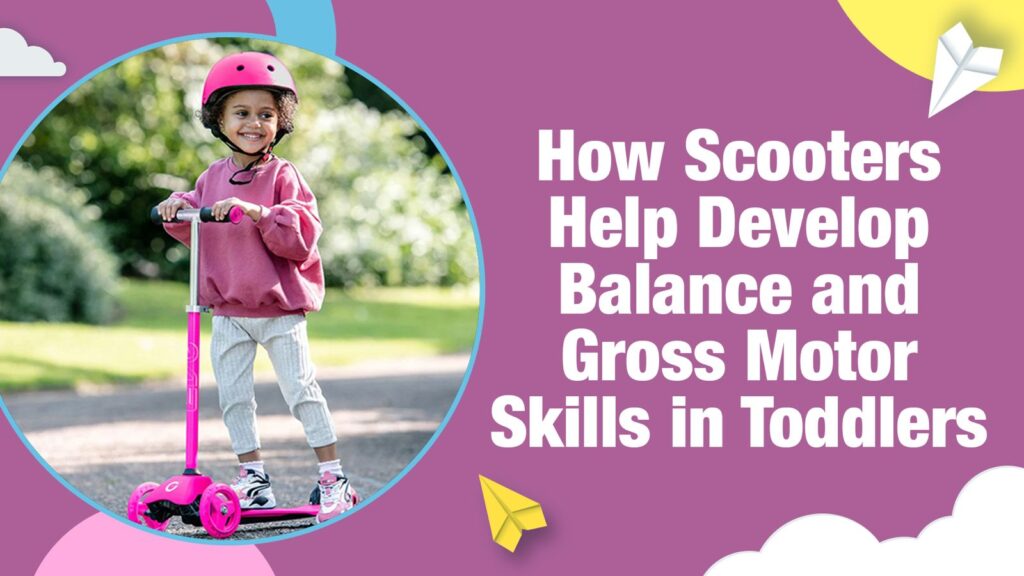
This is where scooters for toddlers shine. A scooter offers dynamic balance training—it challenges toddlers to balance while moving. Learning to shift weight, adjust speed, and steer with intent strengthens their overall physical control and sets the stage for more advanced skills like biking or sports.
Before introducing a scooter, make sure your toddler shows interest in upright movement and can walk confidently. This ensures the scooter serves as an appropriate balance-building challenge—not a frustration.
Even as your toddler develops balance outdoors, don’t forget the importance of rest, hydration, and indoor play tools like a milk bottle newborn station for their younger siblings or family members still in the early stages of development.
How Scooter Riding Supports Gross Motor Development
Scooter riding may look like a simple outdoor activity, but beneath the surface, it’s a comprehensive workout for your toddler’s growing body. Each glide, push, and steering motion strengthens multiple areas of physical development.
Bilateral coordination is one of the first benefits. As toddlers push off with one foot while balancing with the other, they learn to coordinate both sides of their body—a key milestone in gross motor development that also contributes to handwriting, sports, and everyday physical tasks later on.
Scooter riding also builds essential muscle groups. Core strength is constantly engaged to stay upright, while leg muscles are strengthened through repetitive pushing. Even arm and shoulder muscles get involved in steering and grip.
Another important gain is enhanced spatial awareness. As toddlers navigate curves, turns, or uneven surfaces, they improve their ability to judge distance, avoid obstacles, and react quickly to changes in their environment—skills that are vital in safe outdoor play and later, crossing roads or riding bikes.
Parents often ask whether a 3-wheel or 2-wheel model is better. For beginners, 3-wheel scooters offer greater stability and help build confidence before transitioning to a scooter for kids with two wheels, which requires more advanced balance and coordination.
Scooter Benefits for Balance Development
Scooters offer a rare chance to develop dynamic balance—the ability to stay upright while in motion. Unlike static balance (like standing on one foot), dynamic balance demands constant adjustments based on speed, direction, and terrain.
Every scooter ride gives toddlers practice in shifting their weight, adjusting posture, and making micro-movements to stay balanced. These actions strengthen core muscles and the neural pathways that control balance and proprioception (the body’s ability to sense its position in space).
This kind of movement training is crucial in preventing falls and improving coordination across many activities, including climbing, dancing, or running. And because scooting is inherently fun, toddlers are likely to repeat it often—providing natural reinforcement through joyful repetition.
Many parents notice a boost in their child’s self-assurance as balance improves. From wobbly first rides to smooth glides down the driveway, each success builds confidence, reinforcing a positive feedback loop between physical effort and personal achievement.
In short, toddler scooters don’t just train balance—they celebrate it.
Cognitive and Emotional Perks
Beyond the physical gains, riding a scooter also stimulates cognitive growth and emotional resilience.
Toddlers face small decisions constantly while scooting—when to push, how fast to go, when to turn, or stop. These micro-decisions foster executive function, a set of mental skills that include planning, focus, and self-control.
Scooters also support risk assessment, as children learn to balance fun with caution. This helps them build internal safety instincts that are important for outdoor independence.
Emotionally, riding a scooter builds independence and self-esteem. The ability to move freely under their own power empowers toddlers and offers a controlled outlet for energy. Many children express pride after mastering their scooter, which can reduce frustration, tantrums, and anxiety in other areas of development.
In fact, introducing a toddler to a scooter during challenging transitions—like starting preschool or welcoming a new sibling—can offer a stabilizing emotional boost.
In summary, a well-chosen scooter does more than move your toddler from point A to B—it moves them toward greater confidence, coordination, and joy.
Choosing the Right Toddler Scooter
Finding the best scooter for your toddler is more than picking a fun color—it’s about matching features to your child’s developmental needs and safety requirements.
Start with stability. For toddlers aged 18 months to 3 years, a 3-wheel scooter offers a wider base and better balance support. Look for scooters with two wheels in the front for easier steering and weight distribution.
Handlebar height is equally important. Adjustable handlebars allow the scooter to grow with your child and support a comfortable upright stance, reducing the risk of tipping.
Consider the weight and materials. Lightweight scooters are easier for small children to maneuver, while durable materials like aluminum frames and rubber wheels ensure longevity and shock absorption.
Steering mechanism matters too. “Lean-to-steer” models help toddlers develop balance and coordination by shifting weight to turn, while traditional handlebar steering may be easier for slightly older kids.
When deciding between a 3-wheel and a 2-wheel scooter:
- Choose 3-wheel for younger toddlers or first-time riders.
- Switch to 2-wheel only when your child demonstrates strong balance and coordination.
Lastly, safety gear is a must. Equip your toddler with a well-fitting helmet, and consider elbow and knee pads, especially for beginners. Ensure shoes have proper grip and closed toes.
Dondo’s Top Picks: Best Scooters for Toddlers in 2025
Our top recommendations for best scooter for toddlers in 2025 are based on safety, performance, comfort, and parental feedback. Here are Dondo’s expert-tested picks:
1. Micro Mini Deluxe 3-Wheel Scooter
- Key Features: Lean-to-steer, adjustable T-bar, lightweight deck
- Pros: Extremely stable, smooth ride, available in many colors
- Cons: Slightly pricey for entry-level
- Ideal For: Toddlers aged 2–5 just starting out
2. Radio Flyer My 1st Scooter
- Key Features: Extra-wide deck, rear foot brake, 3-wheel design
- Pros: Affordable, beginner-friendly
- Cons: Less maneuverability
- Ideal For: Toddlers aged 2–4 seeking maximum stability
3. Globber Primo Plus Lights
- Key Features: LED light-up wheels, adjustable height, wide deck
- Pros: High visibility for outdoor safety, fun for toddlers
- Cons: Lights may dim over time
- Ideal For: Toddlers aged 3–6 who are more adventurous
4. Yvolution Y Glider Kiwi
- Key Features: Curved design for better stability, ergonomic hand grips
- Pros: Compact fold, good for travel
- Cons: Smaller foot deck
- Ideal For: Families needing a portable scooter option
Optional Comparison Chart
| Model | Age Range | Steering | Weight Limit | |
| Micro Mini Deluxe | 2–5 yrs | Lean-to-steer | 110 lbs | |
| Radio Flyer | 2–4 yrs | Fixed | 50 lbs | |
| Globber Primo Plus | 3–6 yrs | Lean-to-steer | 110 lbs | |
| Yvolution Y Glider | 3–5 yrs | Lean-to-steer | 110 lbs |
Tips for Scooter Practice
To help your toddler make the most of their scooter experience, start with the right approach and a safe environment.
- Start slow: Choose a flat, wide-open space like a quiet driveway, park path, or backyard.
- Demonstrate technique: Show how to push with one foot while keeping the other on the deck, and how to brake safely.
- Set micro-goals: Encourage your child to ride to a nearby object or landmark. Celebrate progress, not perfection.
- Short sessions: Keep early rides under 10–15 minutes to prevent fatigue and frustration.
- Always supervise: Stay close by, especially near streets or sloped areas. Your guidance builds both safety and confidence.
These early experiences set the tone for how your child views mobility and risk. A fun, structured introduction now builds lifelong skills later.
Alternatives to Scooters for Motor Development
While scooters offer many physical and developmental benefits, they’re not the only option. There are plenty of alternatives that also support gross motor skills and balance development, especially for toddlers who aren’t quite ready to scoot.
- Ride-on toys: These allow toddlers to use their legs to move while seated, promoting leg strength and coordination in a lower-risk format.
- Tricycles: Pedal motion builds coordination and bilateral leg use while improving spatial awareness.
- Balance bikes: For slightly older toddlers, balance bikes teach dynamic balancing in a way that naturally transitions into traditional biking.
- Indoor obstacle courses: Set up cushions, tunnels, or stepping stones to create challenges that require crawling, climbing, and balancing.
- Playgrounds and nature walks: Climbing structures, logs, and uneven terrain stimulate proprioception and active body control.
Scooters may not be ideal for toddlers with certain motor delays or sensory sensitivities. In such cases, consult a pediatric physical therapist for personalized alternatives that target specific developmental goals.
Conclusion
Scooters are far more than just a fun way to get from point A to B—they’re powerful tools for building gross motor skills, dynamic balance, and physical confidence in toddlers. With the right scooter and guidance, your child can gain critical coordination, independence, and even emotional resilience through active play.
As parents, recognizing these benefits means we can be more intentional with the gear we choose. And with help from Dondo’s trusted product picks and developmental insight, choosing the right toddler scooter becomes less overwhelming—and more exciting.
So roll into this new stage of mobility with confidence, and explore our full scooter comparison guide if you’re ready to take the next step.
FAQs
1. What age is best to start using a toddler scooter?
Most toddlers can begin using a 3-wheel scooter around 2 years old, depending on their balance and walking ability.
2. Are 3-wheel scooters better than 2-wheel for toddlers?
Yes. For toddlers just starting out, 3-wheel scooters offer greater stability and safety.
3. How do scooters help with balance?
Scooters encourage dynamic balance as toddlers learn to shift weight, steer, and push off while moving, strengthening both muscles and proprioceptive skills.
4. What safety gear is essential for toddler scooter use?
A properly fitted helmet is a must. Optional gear includes knee and elbow pads and grippy, closed-toe shoes.
5. Can scooters delay walking if introduced too early?
Not if used appropriately. Scooters are best introduced once a child is walking confidently. They should never replace early walking milestones but can enhance movement once they’re developmentally ready.
Check out other posts on scooters for kids, milk bottles for new borns and baby walkers.